On Abbottabad


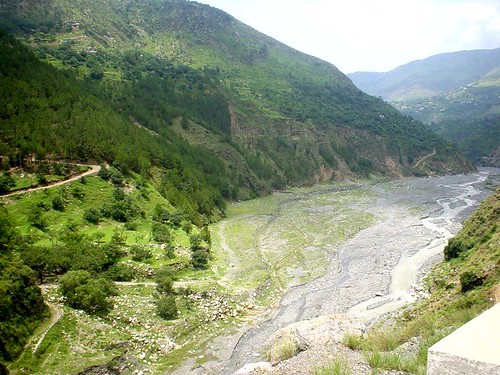
If you are interested in how news starts to follow a narrative especially when facts and boots on the ground are sparse, study the details of the reports on Abbottabad. I happen to have been through Abbottabad as it's on the tail end (or beginning, depending on your direction) of the Karakoram Highway and have a sense of the place. The media has repeatedly defined the city as a suburb of Islamabad (the Pakistani capital) and as a military garrison. Also, interesting, is the description of the house as a mansion/luxury compound and a fortress.

Abbottabad was founded as a British Hill Station, a place where English military officers and officials would escape the heat of cities like Peshawar, Rawalpindi, or Lahore (Islamabad, the Pakistani equivalent of Brazillia, didn't exist yet). The city is a popular tourist destination, weekend getaway, and honeymoon spot for middle and upperclass Pakistanis. THE honeymoon spot is another town called Murree which is higher in the mountains, Abbottabad is sort of a second tier spot.

The city is about 100 km from Islamabad over a road that takes roughly two hours to drive if the traffic isn't terrible which it often is. Many news organizations are reporting the distance between Islamabad and Abbottabad by drawing a straight line on a map without looking at topography. The straight line from Islamabad to Abbottabad crosses very high mountains. The road that actual people travel takes a more circuitous route.

A big prestigious military academy sits on the north side of the town and lots of military folks build retirement and vacation homes there. This is mainly because the Pakistani brass have the the type of money/sway to build houses in popular vacation spots. If you show up in the town center you wouldn't think of the town as being any more or less of military town than any other town in the region (the military has a heavy presence throughout the area). All the cities here have a large number of tribal people and the central government needs the military to reign them in.

Much has been made of the fact that the military owns lots of land in the town, and that the compound couldn't have been built without the military's knowledge, but just as almost everywhere in Pakistan, a little baksheesh greases the wheels and helps avoid questions.

Many if not most of the large homes in the middle and upper middle class areas are surrounded by high walls (often topped by barbed wire or broken glass). Many many multi-family compounds are scattered throughout the city. As far as mansions go, I've seen much nicer looking homes in Pakistan. I presume the primary reason this house stuck out for the intelligence guys was that the size of the house didn't fit the profile of the people who were supposedly living inside it. The lack of phone and internet would also be unusual, but probably not unheard of (many people in Pakistan only use cell phones, and many people, even wealthy ones, are unwired).

A few other impressions: Abbottabad is also something of a college town with dozens of small colleges. Many students would be considered Westernized liberals in Pakistan. One legacy of the British occupation is a sizable Christian population. I distinctly remember hearing church bells in the town. There are still several prominent churches scattered about.

Here are some media characterizations of the city:

"garrison suburb of Abbottabad, about 30 miles from the center of Islamabad" - National Review

"Abbottabad is essentially a military cantonment city in Pakistan, in the hills to the north of the capital of Islamabad, in an area where much of the land is controlled or owned by the Pakistan Army and retired army officers." - New Yorker

"U.S. forces for months had watched the luxury compound in Abbottabad, a city 65 miles from the capital that is home to two Pakistani army regiments" - Washington Post

'"Mansion? Next to a military base? 18 miles from the capital? Staying there for three years?" he said.' - USA Today

" Mr. bin Laden was killed Sunday in a targeted assault in the Pakistani city of Abbottabad, roughly 40 miles outside the capital city of Islamabad." - Wall Street Journal

A more accurate representation:

In August 2010, the intelligence agencies found the exact compound where this courier was living, in Abbottabad. That home was in an affluent suburb of a nondescript garrison town, perhaps selected for its very anonymity and, of course, its good communications and ease of access to the tribal zones. - The Guardian

It will be interesting to see how the picture of the town morphs over time.

Photoset of images from Abbottabd

Flickr photos from Abbottabad, More pictures from a Pakistani journalist

Live Tweeting The Bin Laden Raid

osama-bin-laden-hideout.jpg

Without realizing it, Sohaib Athar, a Pakistani IT Professional from Lahore on a retreat in the vacation town of Abbottabad, live tweeted the 1am arrival of helicopters in the raid that killed Bin Laden.

abbottabad.gif

Other interesting tweets from the area: Another live-ish tweet, It was a known militant hideout, Supposed Post Mortem Picture of Osama circulating in Pakistan (Tin Eye confirms it's a fake- circulating since last year), Some thought helicopter crash was a bomb, lots of choppers, Another local report

Pakistan's English Language Newspaper

Update: Video from a Neighbor

Wild Flavor

If you are interested in food, endangered species, epidemiology, or modern China I recommend seeking out Karl Taro Greenfeld's 2005 Paris Review essay on Guangzhou's 'wild flavor' bush meat restaurants. An excerpt:

Now this style of dining, which was once a quaint local custom, had become industrialized. In one cage at Xinyuan I counted fifty-two cats packed so tightly that their guts were spilling out between the wire bars. There were fifty such cages in that stall. There were fifty-two stalls along that row of vendors. There were six rows of vendors in that market. And there were seven markets on that street. A sharp, musky smell overwhelmed me—the excrement of a thousand different animal species mingling with their panicked breath. I saw at least a dozen types of dogs, including Labradors and Saint Bernards, and there had to be at least as many different breeds of house cat. There were raccoons, dogs, badgers, civets, squirrels, deer, boars, rats, guinea pigs, pangolins, muskrats, ferrets, wild sheep, mountain goats, bobcats, monkeys, horses, ponies, and a camel out in the parking lot. And these were just the mammals. The choice of birds and reptiles was every bit as diverse. Predator was sometimes stacked atop prey. Damaged animals—those that had lost a paw, say—were kept alive with intravenous drips. And because wild animals were more valuable than farm-raised creatures, I was told that some traders would slice off the hind paw of a civet or badger to make it appear to potential buyers that the animal had been trapped in the wild.

I had brought a list of banned animals from the Wild Animal Protection Office. I asked for the rare bird species, the monkeys, the tigers.

“No problem,” I was told by a smiling trader with buckteeth who said he was from Guangxi.

“What about the authorities?” I asked.

“No problem.” He pointed to a fellow in a gray and blue uniform sitting on a white plastic chair, flicking his cigarette ashes by a bag of banned snakes.

“OK, how about mountain lion?”

“No problem.”

“Black bear?”

“No problem.”

I decided to push my luck.

“How about panda?”

He shook his head. “You must be sick.”

The entire article is available in this back issue of the review, as a chapter of the excellent
The Best Creative Nonfiction, Vol. 1
, and as a portion of China Syndrome: The True Story of the 21st Century's First Great Epidemic (which I haven't read but plan to!).

1987

What to do about an old journal?

Blank save for three overwrought pages from 1987 (full of intrigues from forgotten parties) and a small set of drawings (labeled December 1988 of a mountain in Mexico — the view from my abuelito's window).

Then, apparently, nothing. Forgotten until tonight.

Bound in hand tooled chocolaty leather and adorned with hand annotated vintage maps pasted onto the end pages by me, it is a handsome volume — the kind of thing a twenty year old me would think proper to keep on a desk. Inside, the blank unruled pages hate being empty... and I am eager to fill them...

And yet... the emptiness speaks of the years between here and there, so I hesitate.

Hmmm.

Rona Chang

rona-chang.jpg

Rona Chang is a Queens based Chinese photographer working on several ambitious projects investigating man's control (or lack of control) of nature. She writes, "It is the intersection of human, climatic, and geographic realms that are contemplated in my photography." Her image sequencing disorients us (intentionally I believe) by juxtaposing images connected by ideas rather than location. This is work I'd much rather see in person than on the web. Show please.(via flak)

Secret Clubs

R: "Dad, you know that girl Mimi?"

Me: "Yes."

R: "I used to HATE her. Really really hate her. And she HATED me. So much."

[quiet]

R: "But you know what's strange? Now we're in a secret club together. Now we're friends. Don't you think that's so weird."

[quiet]

R: "We're not allowed to have secret clubs in school, but everyone has them anyway."

Me: "What club are you in?"

R: "We're deciding on a name. It's a club I made. We study strange things like ghosts, and toys that move, and shadows that wave at you. Stuff like that. You know spooky stuff. We're writing notes down."

[quiet]

R: "Oh no. I just thought of something. What about vacation? How will we make meetings? I didn't think about that. It might be really bad."

[quiet]

Me: How many people are in your club?

R: "Three. Our club is really really secret. We don't tell anybody. Other people could join, but it takes a special kind of person. Nobody knows about it."

Fortune Cookie

"I mean, I read it, I read it, and I just instinctively sort of, you know, if it says something like: 'Conversation with a dark-haired man will be very important for you,' well, I just instinctively think, you know, who do I know who has dark hair? Did we have a conversation? What did we talk about? In other words there's something in me that makes me read it, and I instinctively interpret it as if it were an omen of the future, but in my conscious opinion, which is so fundamental to my whole view of life, I mean, I would just have to change totally to not have this opinion, in my conscious opinion, this is simply something that was written in the cookie factory, several years ago, and in no way it refers to me! I mean, you know, the fact that I got--I mean, the man who wrote it did not know anything about me, I mean, he could not have known anything about me! There's no way that this cookie could actually have to do with me! And the fact that I've gotten it is just basically a joke! And I mean, if I were to go on a trip, on an airplane, and I got a fortune cookie that said 'Don't go,' I mean, of course, I admit I might feel a bit nervous for about one second, but in fact I would go, because, I mean, that trip is gonna be successful or unsuccessful based on the state of the airplane and the state of the pilot, and the cookie is in no position to know about that."

-Wallace Shawn in My Dinner With Andre

Related: The Elephant Vanishes, The Screenplay

Edible Selby

edible-selby-.jpg

A few years ago Todd Selby photographed scores of creative people in their work spaces for the project The Selby Is in Your Place. Now he's back photographing the people making modern food culture and their workspaces with Edible Selby. I predict this project will be just as popular as the first. To use an overused term, it's a visual feast.

Robert Polidori

110411_polidori-08_p465.jpg

Robert Polidori's Yemen pictures from a 1996 assignment are interesting, but are presented very very small and without much context. Come on New Yorker! Bigger pictures! More words!

Poliodori did not know what was going on in the image above. And anyone who has travelled far away knows the phenomenon of the strange child vagabond, who appears, watches, and vanishes. The blackface must have some significance. Do any of the readers here have any idea? The only reference I could find online this one which seemed to be about another custom.

Polidori is known for popular coffee table book architectural projects covering Versailles, Havana, Chernobyl etc... but I much prefer this looser style of work from Yemen. Where can we see more?

My 6 year old from his bunk bed

R: Dad do you remember before I was born?

Me: Yes.

R: Was everything the same?

Me: You weren't here, so it was different. We were lonely but we didn't know it.

R: Where was I?

Me: You weren't made yet.

R: Sometimes I think I remember.

Me: Before you were born?

R: Yeah. It just was like space or something.

Me: What did it feel like?

R: Sad. I didn't know anything. I didn't even know what to think. Maybe I was lonely. I don't know. It's complicated to think about. I remember things from a long time ago.

[Quiet]

R: Did you ever travel to a high mountain before I was born?

Me: Yes.

R: I remember that. The stars were beautiful.

---
Later:

R: I saw a ghost in your room.

Me: What did it look like.

R: It was standing by your bed while you were sleeping. I was scared.

Me: Ghosts aren't real.

R: That one was.

---
Later:

R: Dad are you still there?

Me: Yes.

R: What are you doing.

Me: Thinking.

R: I like all kinds of mammals.

Quiet. Then snoring.

Replaced

replaced-mona-lisa.jpg

"Replaced" by artist Mike Ruiz was created by using photoshop's content aware fill to paint out the Mona Lisa, leaving only her background. The image was then sent to a Chinese copy artist to be painted in oil.... It's a nice try for a computer + copy artist, but I don't think the landscape would be so photoshoppy repetitive, I'll bet the copy artist could have done better on his/her own. Also shouldn't the title be 'Removed'?

I've seen a couple of artworks playing on this idea although this and this one are the only ones I've found online (as an aside MegaMonaLisa is one of the more bizarre sites I've stumbled upon this week).

The landscape in the background has long been a source of studys. One popular theory holds that the background is a painting of the landscape near Bobbio in Northern Italy, based on the theory that the numbers 7 and 2 (hidden in a span of the bridge in the painting) refer to 1472, when a flood washed away Bobbio's bridge. This seems farfetched to me.

Some believe the bridge is the Buriano, near Arezzo. Other historians based on information in Leonardo's topological surveys believe the background depicts the area near the confluence of the Arno and Chiana rivers (In this scenario the sitter obscures a view of Lake Chiana). This seems like a more reasonable theory to me, although it's just as likely Leonardo just drew a background he created from whole cloth.

(Mike Ruiz image is via Good)

The Liljenquist Family Collection of Civil War Photographs

liljenquist-civil-war.jpg


The Library of Congress is featuring a large collection of over 300 Civil War ambrotypes and tintypes. They're beautiful, especially at high resolution—and the Library has included high resolution downloads for almost every image, with more variety than I've ever seen in one place. Always be sure to read the captions. Many are heartbreaking and the words tend to fold the distance between the 1860's and today.

A flash slideshow of a few curators picks can be found here, but the best way to view the pictures is to just dive in.

Archive

1999 — 2026
2026
Jan Mar Apr May Jun Jul Sep
2025
May Jun Oct
2024
2023
2022
2021
Jan
2020
Mar Apr May Jun Jul Oct Dec
2019
Jan
2018
Apr
2017
Oct Nov
2016
Mar
2015
Dec
2014
Oct
2013
Mar Apr May
2012
Jan Feb Mar May Jun Jul Aug Sep Oct
2004
Mar Jul Aug Sep Oct Nov Dec
2003
Mar Apr
2002
2001
2000
1999
May