Pyongyang Painters is one of the stranger art sites I've encountered. It features "beautiful original paintings from the Democratic People’s Republic of Korea (DPRK)." The site is hosted in the US. Only accepts bank transfers and is run by Felix Abt a Swiss North Korean affairs specialist. The site says it included: "Novelties", "Stories about the artists", and "Information on the great skill of North Korean artists."
The barometer gave no warning, no indication of any unusual conditions on June 15, and the occurrence of thirteen light earthquake shocks during the day excited no comment. Rain had fallen in the morning and afternoon, and with a temperature of 80° to 90° the damp atmosphere was very oppressive. The villagers on that remote coast adhered to the old calendar in observing their local fêtes and holidays, and on that fifth day of the fifth moon had been celebrating the Girls' Festival. Rain had driven them indoors with the darkness, and nearly all were in their houses at eight o'clock, when, with a rumbling as of heavy cannonading out at sea, a roar, and the crash and crackling of timbers, they were suddenly engulfed in the swirling waters. Only a few survivors on all that length of coast saw the advancing wave, one of them telling that the water first receded some 600 yards from ghastly white sands and then the Wave stood like a black wall 80 feet in height, with phosphorescent lights gleaming along its crest. Others, hearing a distant roar, saw a dark shadow seaward and ran to high ground, crying "Tsunami! tsunami!" Some who ran to the upper stories of their houses for safety were drowned, crushed, or imprisoned there, only a few breaking through the roofs or escaping after the water subsided.
Yeondoo Jung has been much blogged for his series wonderland where he makes photographs based on children's drawings, but my favorite body of work is his Location series in which he creates environments on stage sets.
Of this body of work he writes:
Ⅰ. Do not try to distinguish between the real and fake landscape in these pictures.
Ⅱ. If you must, do it just for fun as if you are breaking a puzzle. The cost of this will be the fun of appreciating the real thing.
Ⅲ. See the details and appreciate the fact that the space we live in is an assemblage full of clich?s and many different objects.
Ⅳ. Reflect on how much ‘awkwardness’ can be found in the things that we took for granted; the movie scenes are that once we dreamed about, the landscape of far places that made our heart flutter, the romantic lyrics of the pop songs that we used to sing along.
Ⅴ. Amuse yourself with all the fakes, imitations, performances that are audaciously set before the real landscape. The real reality is here for you.
Ⅵ. Pay a tribute to the artist who created, assembled and directed all these fakes, imitations and performances. Thanks to him we were able to take a glimpse on the fragments of the shell that holds our slightly upside down world.
Ⅶ. Be aware. Think how confident the artist must be to hide the real as fakes and visualize fakeness so audaciously.
To quote a line from a trendy soap opera, “Let’s say that the real is disguising the fake as the real. In a situation where the real is acting as the fake as a substitute of the fake, how threatening the fake real must be! It must be indeed a matter of truth and genuineness.”
Jasper, Cleveland, Vidor — they're all East Texas towns you drive through on the way from somewhere to somewhere. They're towns of mobile homes, wood framed houses, small churches, and barber shops. They're not places you notice. But now each of these places is synonymous with the horrible things that happened there. I grew up in this part of the country and the news about the rape Cleveland was particularly unsettling because I felt as if I was reading about people I might have known in school. The last names, the scenery, the house where bad things happen, all are familiar archetypes from an East Texas childhood. In my town there was a building called The Front. Everyone knew bad things happened there. Nobody talked about it. I imagine this was something similar. The details of this case are shocking. 19 men ages 14-29. An 11 year old girl. Rapes over three months. The inclination in the community will be "take care" of this situation and forget about it, to blame the devil, and to protect themselves from the darkness around the case. You can already see this happening in the news coverage. My hope is that the case will force people to ask questions... just maybe, the right questions will help shine light into this community and ask how this could happen. There will be no easy answers.
Perhaps because of all this, I've been thinking about a show at the International Center for Photography titled Jasper, Texas: The Community Photographs of Alonzo Jordan. It's a loving portrait of people in Jasper but it could easily be a portrait of folks in Cleveland or Livingston, or Woodville, or any of the other small communities in East Texas. If you are in New York, it's worth visiting and it's worth asking yourself when you look at the images how these communities get from where they were then to where they are now.
p.s. Speaking of the IFC they have another show up on rural baptism rituals that looks pretty amazing. It's titled Take Me to the Water. I hope to see it soon.
Charlotte Bronte's diary
The city was full of art over the last few days with competing fairs and scores of gallery exhibits, but the of all the art around, the thing I will remember from the weekend is the show at the Morgan Library called "The Diary: Three Centuries of Private Lives". The website is terrible (The exhibition is small. Why so few scans? Why so few transcriptions? Why are the scans so small?! Why do so many of the podcasts have to be read by someone that sounds like that English teacher you disliked in 7th grade? Etc. etc.) so don't bother, just go visit the Museum in person. You'll read Nathaniel Hawthorn muse in a diary about a story he's considering on “the life of a woman, who by the old colonial law was condemned always to wear the letter A…” You'll read Stuart Davis' "Complete formula for artistic & financial Success." And you'll see Charlotte Bronte's tiny handwriting, that alone was worth the trip for me.
Sidenote: Be sure to grab the xeroxed transcriptions as you walk in the door. They're easy to miss.
Photographs taken of the front and back of the Mona Lisa's empty frame after it's theft (the frame was abandoned in a staircase during the Peruggia's getaway).
In 1911 an Italian named Vincenzo Peruggia managed to steal the Mona Lisa from the Louvre. The Museum and the police were mystified. "La Gioconda is gone. That is all I can say. So far we have not the slightest clue as to the perpetrator of the crime," reported the Assistant Curator of the Louvre to the NYTimes.
Peruggia secreted the painting to his small apartment two blocks from the museum and kept it hidden for almost two years. I often wonder if, during those years, he kept the painting locked up in the secret false bottom of his trunk (where it was eventually found), or if, sometimes, he would take it out and and hang it while he made himself dinner and enjoyed a glass a wine. I love the mental image of Peruggia alone at table breaking bread with Mona Lisa's eyes always on him.
The National Archives have released a film (in color) of the OSS visiting Tibet in 1942. The scenes approaching Lhasa are especially spectacular if you've been there any time in the last 20 years.
The grandfather of an acquaintance of mine was on one of these OSS trips and ended leaving his American wife (the grandmother of my friend) for a Tibetan woman — that's the story I want to hear.
Nicholas Felton published his annual report today. Unlike years past where he cataloged, analyzed, and quantified a single year of his own life, this time he examined the life — the entire life — of his father Gordon Felton, who died in 2010. Nick studied scores of documents, calendars, postcards, and pictures to build a portrait of his dad in data. And it's quite a portrait. By triangulating his father's movements, Nick literally maps the shape of the world with the forms of continents emerging from the mesh of connecting lines (Felton Sr. was one hell of a traveler). The document is full of stories "Name legally changed to Gordon Felton in the province of Manitoba September 9, 1954 at 4:15" and facts both amusing ("Middle name Paul added in 1968") and heartbreaking (Last Day Sep 12, 2010 81 years, 2 months and 8 days old). Ultimately though, the document is a set of mysteries. Reading it reminded me of the questions asked by Rawlston in the opening scene of Citizen Kane after the newsreel ends.
                RAWLSTON

      What made Kane what he was?

      And, for that matter, what

      was he?  What we've just seen are the outlines

      of a career - what's behind the

      career?  What's the man?  Was he good or bad?

      Strong or foolish?  Tragic or silly?

      Why did he do all those things?

      What was he after?
These are questions that will not be answered by this report, but they are the type of questions the report raises. The questions make the man real to people who never knew him. How did this elevator operator find himself at the far end of the Soviet Union. Why was he in Vietnam? Why that middle name? Why the divorces? What happened in 1964?
Anyone who has lost someone close knows the complicated emotions brought on by the sorting of the collected ephemera of a life. Some survivors live with the stuff, some put it in boxes and hide it away, some throw it out. Nicholas did something harder, he tried to understand the things his dad left behind, and then he tried to make us understand. I see this as a courageous act of love. It shows on every page of the report and that's a beautiful thing.
When I was a kid I thought if I could memorize the encyclopedia that I could understand the whole world. Good old fashioned paper encyclopedias are almost extinct these days, but I recently discovered the Smithsonian Natural History visual reference. It's a visual encyclopedia for the natural world with 600 pages and thousands of photographs. In my house it's quickly become a favorite. My kids use it constantly, for projects or just to discover something new. Best of all it's only around $30. Easily the best $30 I've spent on my kids in ages.
Phillip Toledano has created a new body of work titled Kim Jong Phil. He writes:
"For my palette, I've copied pre-existing dictatorial art. Paintings from North Korea, statues of assorted dictators (Kim Il Sung, Laurent Kabilla, and Saddam Hussein). I had these works re-created in China, and each instance, I've replaced the great leaders with myself."
I finally dug through the original archive myself at the The Historic Houses Trust site today. It's well worth the visit. The site allows download of full resolution versions of the images and provides context. Many of the descriptions are like that famous 6 word Hemingway short, "For sale: baby shoes, never worn."
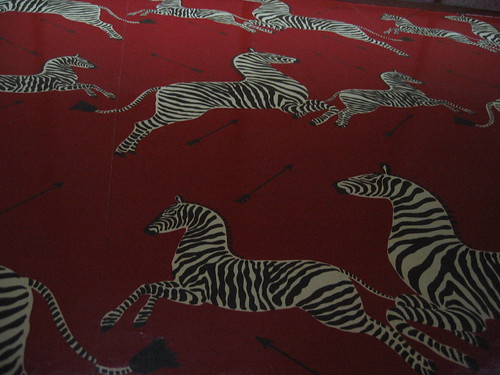
In my 20's I went there regularly, not for the food—I never had a truly great meal there—but for the crowd. It was the type of place you might run into Woody Allen or Gregory Peck, you might be seated next to a table of pinky-ringed Italian men in shark skin suits, or you might find yourself next to a Mets pitcher who ate there for good luck. Why this place? The room was nothing special, just a dark rectangle hung with low grade office ceiling tile. The lighting was lousy, and there were those damned plastic flowers in cheap sconces. It wasn't like Dan Tana's in LA, with it's red leather booths and feel of faded glamour. Gino's was almost lowbrow, but it had an irresistible sense of style regardless. The yellow door was just the right yellow, the green sign was EXACTLY what it was supposed to be, and the red zebra wallpaper was... well, perfect. The zebras, in addition to being on the walls, could be found on the matches and the napkins and the doors to the bathrooms. Gino must have known he was on to something, because those zebras became design icons in their own right. Without the zebras, the room is nothing special. I always said the zebras helped carry the place through time.
When the restaurant was slated to close Gay Talese wrote, "All the items on the menu appear on a single plastic-covered page and were handwritten in ink sixty-five years ago by the restaurant’s founder, Gino Circiello, a dapper and debonair trendsetter in 1945 who thereafter ignored all trends. Even a year after his death at eighty-nine, in 2001, when the restaurant was described in the Zagat Survey as “frozen in the 40’s,” the regulars liked to boast that, at Gino’s, nothing was new: within the zebra-covered walls of this place everything remained the same, including the fact that a stripe was missing from the rumps of half the zebras—a mistake made by the original designer which Mr. Gino, a superstitious Italian of Neapolitan origin, chose not to correct, because to do so, he feared, might bring him bad luck." (full article)
Don't know why I was thinking about Gino's today, but I wanted the wallpaper for my computer. I couldn't find a digital copy so I made one myself: Gino's Digital Zebra Wallpaper. I left the stripe off the rump.